
Forest Hills, Queens
Tudor rooftops, a private garden village, prewar co-ops, and Austin Street's shops, all about 15 minutes from Midtown by train.
A neighborhood guide by Jacques Ambron, Executive Vice President, Brown Harris Stevens. Raised in Forest Hills; working here for 45+ years.
A short history
Before it had a name, this was farmland known as the Hopedale section of Whitepot. The new bridges and rail tunnels of the early 1900s turned central Queens into commuter country, and Forest Hills was one of the first planned neighborhoods to follow.
1906The Cord Meyer Development Company buys about 600 acres and names the area for nearby Forest Park and its high ground.
1909The Russell Sage Foundation, led by Margaret Olivia Sage, buys 142 acres to build Forest Hills Gardens.
1913The West Side Tennis Club moves in. It hosts the U.S. national championships, later the U.S. Open, until 1977.
1917Theodore Roosevelt addresses a crowd at Station Square.
1936The Queens Boulevard subway reaches Forest Hills, and apartment buildings follow along the boulevard.
1960s–70sThe tennis stadium becomes a concert stage (the Beatles played there in 1964), and the Ramones form in the neighborhood.
2013Forest Hills Stadium reopens as one of the city's favorite outdoor concert venues.
Forest Hills Gardens
Forest Hills Gardens is one of the earliest planned garden communities in America. Architect Grosvenor Atterbury and landscape architect Frederick Law Olmsted Jr. (son of Central Park's co-designer) modeled it on an English village, inspired by the Garden City movement.
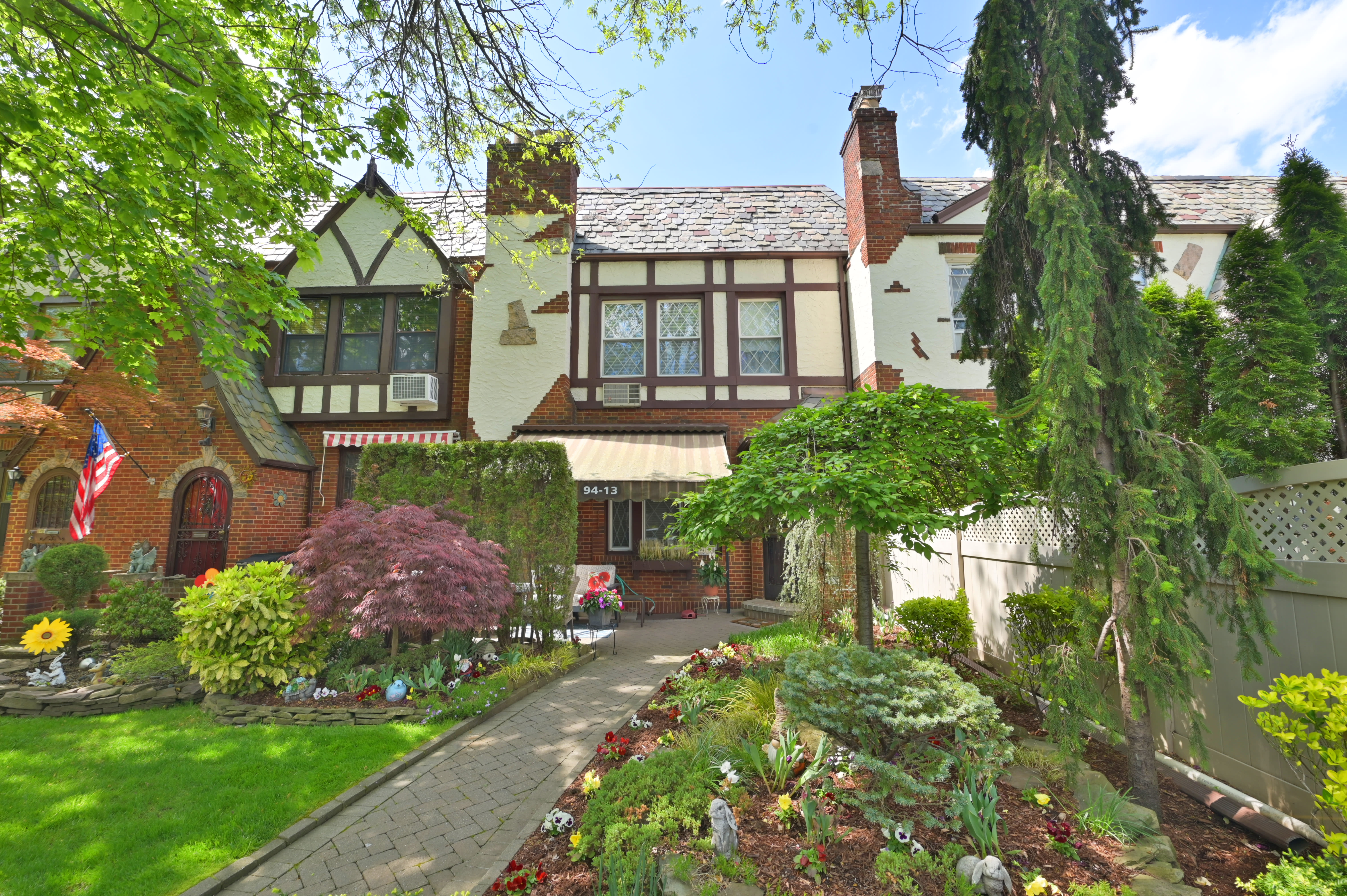
Curving streets discourage through-traffic. Homes were built in Tudor and Georgian styles with brick, stone, half-timbering, and red-tile or slate roofs. Atterbury used precast concrete panels, a new technique at the time, which let much of the village rise in just a few years.
What's there
About 800 houses and 11 apartment buildings on roughly 175 acres, plus churches, private parks, and the West Side Tennis Club.
Station Square
The Gardens' front door: a brick plaza under the LIRR trestle, framed by arches and the Tudor-style Forest Hills Inn (1912, now apartments).
How it's run
The Forest Hills Gardens Corporation maintains the private streets and enforces covenants dating to 1913, including approval for exterior changes.
Buying in the Gardens? Ask about the covenants, the annual assessment, and parking rules before you make an offer. I'm happy to walk you through them.
Learn more: The Cultural Landscape Foundation · Historic Districts Council · Forest Hills Gardens Foundation
Architecture
Tudor and English Revival sets the tone: steep gables, half-timbering, leaded windows, and slate or clay-tile roofs, most famously in the Gardens.
Prewar elevator buildings from the 1920s and 1930s line Austin Street, Queens Boulevard, and the side streets nearby. Many are Tudor-style themselves, with generous layouts, sunken living rooms, and plaster detail.
Cord Meyer section, north of Queens Boulevard: detached Colonials, Tudors, and a growing number of newer, larger custom homes on wider lots.
Postwar and new construction: high-rise co-ops and rentals along Queens Boulevard, and boutique condominiums such as The Austin (78-29 Austin Street, completed 2024).
Homes & property types
Co-ops
The largest share of what sells here. Prewar and postwar buildings, from studios to large three-bedrooms. Expect board approval and a monthly maintenance that includes property taxes.
Condos
A smaller, newer slice of the market. Fewer purchase restrictions, easier to rent out, and usually higher prices per square foot.
Houses
Single-family homes in the Gardens and the Cord Meyer section, plus attached and two-family homes on the neighborhood's edges.
Rentals
Prewar walk-ups, doorman towers along Queens Boulevard, and newer amenity buildings.
Recent 2026 sales ran from about $250,000 for a one-bedroom co-op to $2.4 million for a new condo townhouse, and detached homes in the Gardens often trade well above that. Numbers move monthly, so ask me for a current market report.
Community
Getting around. The E, F, M, and R trains stop at 71st Avenue–Forest Hills, and the LIRR's Forest Hills station at Station Square reaches Penn Station in about 15 minutes.
Green space. Forest Park, with over 500 acres of trails, a golf course, and a historic carousel, sits along the southern edge. Flushing Meadows–Corona Park is a short trip north.
Schools. Forest Hills is part of NYC's District 28. Look up zoned schools by address with the NYC School Search tool.
Civic life. Community Board 6, active civic and tenant associations, houses of worship of many faiths, and the Forest Hills branch of the Queens Public Library.
Restaurants
Jacques's picks
5 Burro Cafe: a festive Mexican institution on Austin Street for over 30 years. Order the frozen margarita.72-05 Austin St
Tuscan Hills: warm, brick-walled Tuscan trattoria with brick-oven pizza and handmade pasta. Try the wild boar ragù.110-60 Queens Blvd · (718) 487-4500
La Boulangerie de François: a true French bakery. Don't leave without the pistachio éclair.109-01 72nd Rd
Eddie's Sweet Shop: an old-fashioned ice cream parlor, open for about a century. A Forest Hills rite of passage.105-29 Metropolitan Ave
Neighborhood classics
Nick's Pizza: thin-crust pies in vinyl booths. Whole pies only.108-26 Ascan Ave
Manor Oktoberfest: a German beer hall with schnitzel and spätzle.73-11 Yellowstone Blvd
Dinner out
Spy C Cuisine: Sichuan, and some of the best Chinese food in the area.72-06 Austin St
Nick's Bistro: Greek, with kebabs and stuffed grape leaves.104-20 Metropolitan Ave
Agora Taverna: Greek seafood.70-09 Austin St
Cabana: Latin American, relaxed, good for groups.107-10 70th Rd
Matiz Latin Cuisine: lively, open late on Saturdays.110-72 Queens Blvd
Paratha Wala: Indian and Bangladeshi.103-09 Metropolitan Ave
Casual, quick & sweet
Austin Street Pizza: crunchy square slices near the subway.71-63 Austin St
Stacked Sandwich Shop: huge heroes, with plenty of vegan options.68-60 Austin St
Pahal Zan: kosher Middle Eastern takeout.106-12 Continental Ave
Before or after a show
Forest Hills Station House: a gastropub by the LIRR. No reservations on concert days.106-11 71st Ave
Dirty Pierre's: famous mussels, steps from the stadium.13 Station Square
More picks: The Infatuation's Forest Hills guide. Restaurants change; confirm hours before you go.
Shopping
Austin Street is the neighborhood's main street, named for 19th-century LIRR president Austin Corbin. The shopping stretch runs about three-quarters of a mile from Yellowstone Boulevard to Ascan Avenue, mixing national names with independent boutiques, cafés, and services.
Natural Market: a longtime local grocer known for its produce.72-56 Austin St (at Ascan Ave)
Banana Republic Factory71-18 Austin St
Ann Taylor Factory71-09 Austin St
Target: a compact store for everyday essentials.70-00 Austin St
Sephora71-30 Austin St
Martha's Country Bakery: cakes, pastries, and coffee.70-28 Austin St
Station Square and Continental Avenue hold small shops at the edge of the Gardens.
Metropolitan Avenue, on the south side, is a quieter strip of neighborhood businesses, Eddie's, and several restaurants.
Queens Boulevard has the Forest Hills Greenmarket and larger stores. Rego Center and Queens Center mall are a short drive west for big-box shopping.
Events through the year
Forest Hills Greenmarket: every Sunday, year-round, 8 a.m.–2 p.m. Queens Blvd at 70th Ave, by the post office. GrowNYC
Forest Hills Stadium concerts: outdoor shows, roughly May through early fall, inside the West Side Tennis Club. Schedule
Forest Hills Festival of the Arts: late spring street fair on Austin Street, 69th Rd to 72nd Rd, with crafts, food, and live music.
Austin Street Fall Festival: early September on the same stretch.
Austin Street Open Streets: car-free Sundays with games and activities, launched in 2026. QNS coverage
Forest Park: seasonal concerts, carousel, and NYC Parks programs. Events
Dates change each year. Check the organizer's site before you go.
Thinking about Forest Hills?
I grew up here, and I've guided buyers and sellers through more than 700 transactions over 45+ years. Whether it's a prewar co-op, a new condo, or a Tudor in the Gardens, I can help you price it right, prepare for the board, and move with confidence.
Call or text Jacques today: 718-974-4279
Office: 718-878-1970 · jambron@bhsusa.com
Brown Harris Stevens, 73-01 Austin Street, Forest Hills, NY 11375
Jacques Ambron, Licensed Real Estate Broker, Executive Vice President & Managing Director of Sales, Brown Harris Stevens. Information is believed reliable but not guaranteed. Equal Housing Opportunity.